On this page
In a small randomized study, a diet rich in fermented foods increased gut microbial diversity and reduced several inflammatory markers. That is evidence about a varied diet in healthy adults. It does not establish that one serving of kimchi, yogurt or kefir will produce the same changes, or that every fermented food acts as a probiotic.
What did the Stanford study measure?
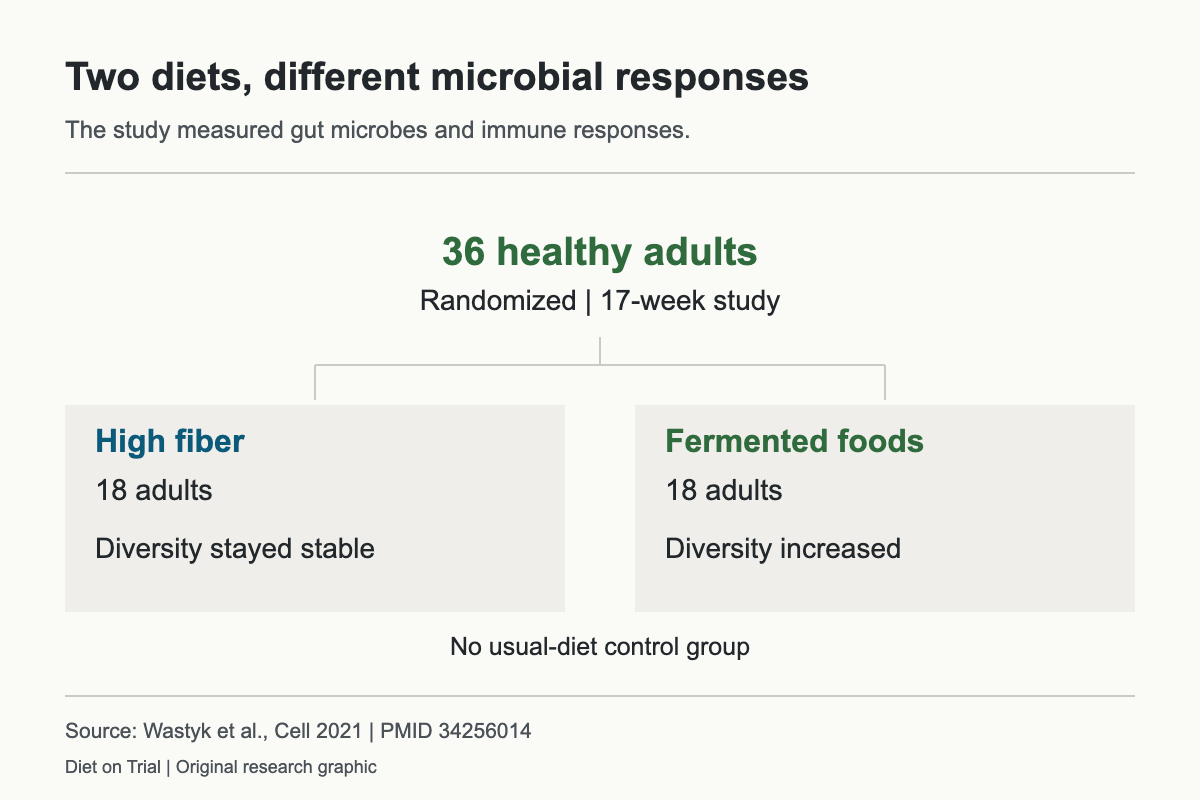
Wastyk and colleagues compared high-fiber and high-fermented-food diets in a 17-week study, with 18 healthy adults assigned to each group. Researchers measured gut microbes and immune responses repeatedly.
The fermented-food group showed increasing microbial diversity and lower inflammatory markers. The high-fiber group showed increased microbial capacity to break down carbohydrates, while diversity stayed stable. This means the two interventions changed different measurements; stable diversity is not proof that fiber had no effect.
The trial had no usual-diet control group. Its size and participants also limit claims about treating a disease. It supplies a reason for further research, rather than a universal food dose.
Kimchi and other fermented vegetables
Kimchi has also been studied separately, with different outcomes. A 2011 crossover trial enrolled 22 adults with overweight or obesity. Participants ate fresh and fermented kimchi during two four-week phases separated by a two-week washout.
The fermented version produced more favorable changes in several metabolic measures than fresh kimchi, including fasting glucose and total cholesterol. This was a short metabolic study. It did not answer the same microbial-diversity question as the Stanford trial, and it does not show that all fermented vegetables have identical effects.
| Study | Participants and duration | Main question relevant here |
|---|---|---|
| Wastyk and colleagues | 36 healthy adults, 17 weeks | How diets changed gut microbes and immune measurements |
| Kim and colleagues | 22 adults with overweight or obesity, two four-week phases | How fresh and fermented kimchi affected metabolic measures |
Keeping those questions separate prevents a common mistake: presenting every favorable result as if it proves the same gut-health claim.
Does fermented mean probiotic?
No. The ISAPP consensus statement distinguishes foods made by fermentation from probiotics. Fermentation describes how a food is made; a probiotic claim concerns microorganisms with a demonstrated health benefit. The word “fermented” on its own does not supply that evidence.
When comparing products, identify the food and the claim being made. A kimchi experiment does not validate a capsule containing a different microorganism, and a trial of a varied fermented-food diet does not isolate one yogurt brand.
Where does fiber fit?
Fermented foods do not settle the question of daily fiber intake. The fiber and gut guide covers that separate role, including evidence for psyllium in constipation. The choice does not have to be framed as fiber versus fermentation simply because researchers separated them into two study groups.
Frequently asked questions
Did the study prove that fermented foods treat constipation?
No. The cited diet study focused on microbial and immune measurements. Constipation requires its own clinical evidence.
Can I apply the kimchi results to every fermented vegetable?
No. The trial compared fresh and fermented kimchi under its own protocol. It did not test every fermented vegetable.
Is greater microbial diversity a complete measure of health?
The study measured diversity alongside immune responses. It did not establish diversity alone as a diagnosis or a treatment target for an individual reader.