On this page
An eating window can be a way to organize meals, but it did not produce greater weight loss when researchers provided the same calories to both groups in a 12-week trial. A separate year-long study also found no clear extra weight-loss benefit from adding an eight-hour window to calorie restriction.
What happens when calories are actually matched?
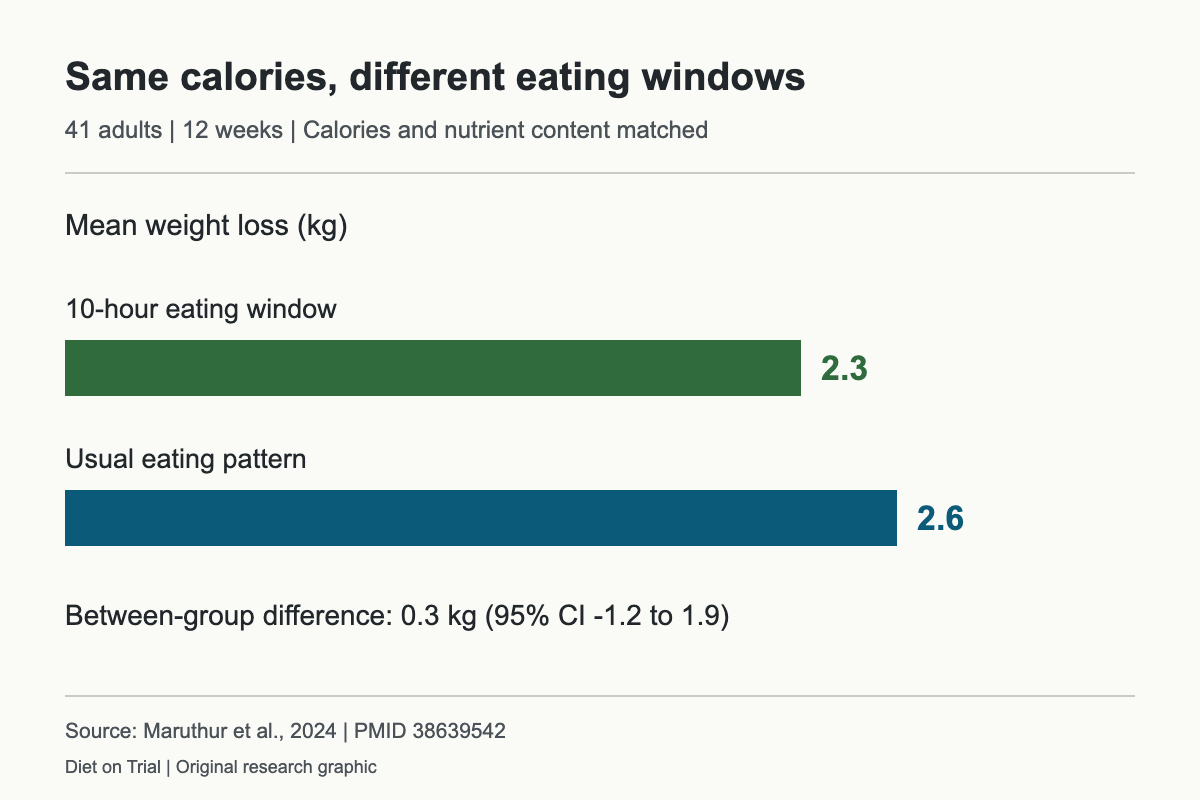
A 2024 feeding trial enrolled 41 adults with obesity and prediabetes or diet-controlled diabetes. One group ate within 10 hours and consumed most calories earlier in the day. The comparison group had an eating window of up to 16 hours. Both received diets matched for calories and nutrient content.
After 12 weeks, weight fell by 2.3 kg in the time-restricted group and 2.6 kg in the comparison group. The between-group difference was 0.3 kg, with a 95% confidence interval from -1.2 to 1.9 kg. Blood glucose measurements did not differ between the groups either.
This small, single-site study tested a specific schedule under controlled feeding. It cannot establish that every fasting schedule has the same effect, but it directly addresses whether moving the same food into a shorter window causes extra weight loss.
What happened over a full year?
In a 2022 trial, 139 adults with obesity were assigned either calorie restriction alone or the same calorie prescription with eating limited to 8 a.m. through 4 p.m. Of those randomized, 118 completed the 12-month visit.
Mean weight loss was 8.0 kg with the eating window and 6.3 kg with calorie restriction alone. The reported between-group estimate was -1.8 kg, with a confidence interval from -4.0 to 0.4 kg. The difference was not statistically significant. This was a shared calorie prescription, rather than the fully matched food provision used in the 2024 experiment.
| Trial | What was controlled | What it found |
|---|---|---|
| 2024, 12 weeks | Calories and nutrients in supplied food | No clear additional weight loss from the eating window |
| 2022, 12 months | Prescribed daily calorie restriction | No clear additional benefit from the eight-hour window |
Choosing an approach you can follow
The findings give no reason to force an eating window that repeatedly conflicts with work or family meals solely for an assumed extra weight-loss effect. Conversely, a convenient window can still be useful as a personal routine. That practical choice is different from claiming that fasting has a special effect independent of calories.
Food quality remains a separate decision. The Mediterranean diet concerns the foods eaten, while time-restricted eating concerns when they are eaten. One label does not describe the other.
For people taking diabetes medicines, NIDDK's fasting guidance identifies hypoglycemia and inappropriate medication changes as risks. Arrange the medication and glucose-monitoring plan with the prescribing clinician before fasting.
Frequently asked questions
Does eating earlier guarantee greater weight loss?
No. In the matched-calorie trial, shifting more food earlier did not produce a clear weight-loss advantage.
Is time-restricted eating the same as alternate-day fasting?
No. The trials described here used a daily eating window. They do not directly test an alternate-day schedule.
Can I combine an eating window with a Mediterranean diet?
The terms describe different parts of eating: timing and food selection. These two trials do not establish that the combination is superior to Mediterranean eating without a time limit.