On this page
Oat beta-glucan can lower LDL cholesterol. Research measures grams of this soluble fiber, not simply the number of bowls of oatmeal eaten. To relate a product to the evidence, look for the beta-glucan amount per serving and distinguish it from total fiber or total oats.
What did the larger review find?
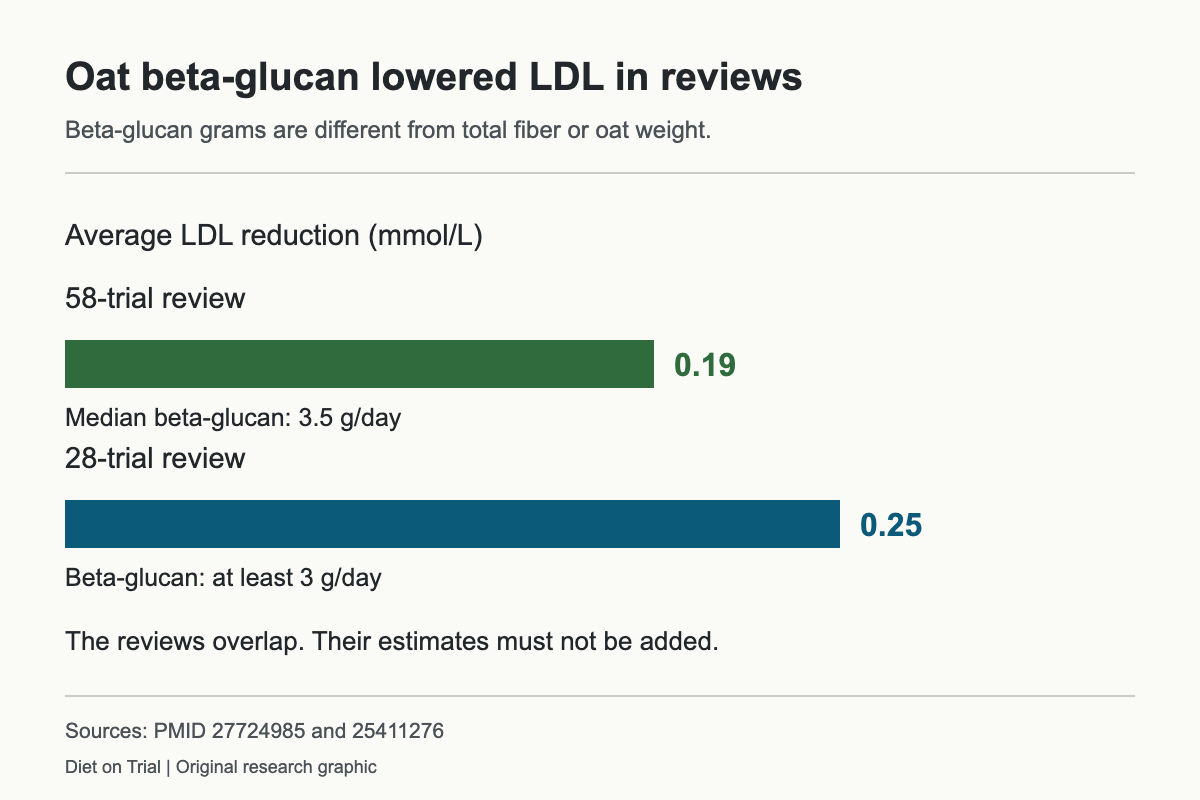
A 2016 meta-analysis pooled 58 randomized trials involving 3,974 people. Studies lasted at least three weeks and used a median of 3.5 g of oat beta-glucan per day.
Compared with control diets, LDL cholesterol fell by an average of 0.19 mmol/L, with a 95% confidence interval from 0.14 to 0.23 mmol/L lower. Non-HDL cholesterol and apolipoprotein B also decreased. Results varied considerably between trials, so the pooled mean should not be treated as an individual guarantee.
Does another review agree?
A meta-analysis of 28 trials restricted its comparisons to at least 3 g of oat beta-glucan daily. It found reductions of 0.25 mmol/L in LDL and 0.30 mmol/L in total cholesterol, without a statistically significant effect on HDL or triglycerides.
| Review | Included evidence | Average LDL reduction |
|---|---|---|
| Ho and colleagues | 58 trials, median 3.5 g/day | 0.19 mmol/L |
| Whitehead and colleagues | 28 trials, at least 3 g/day | 0.25 mmol/L |
The estimates come from overlapping research reviewed under different criteria. They should not be added together, or presented as two separate doses whose effects accumulate.
What does the US health claim require?
21 CFR 101.81 links qualifying soluble fiber from oats or barley with a diet low in saturated fat and cholesterol. The rule specifies at least 3 g per day of beta-glucan from eligible oat or barley sources and qualifying amounts per labeled serving.
This is a conditional food-label claim. It does not mean every product with “oats” on the front provides the amount, or that a food label authorizes a claim to treat an existing disease.
How to compare oatmeal and other oat foods
Start with the actual serving you will eat. Then look for a stated beta-glucan amount. A total-fiber value combines fiber types and does not, by itself, tell you how much beta-glucan is present.
Without a product-specific amount, it would be misleading to convert the study dose into an exact number of bowls. Bowl sizes, dry serving sizes and formulations differ. A generic conversion could make a small portion appear to match an intervention that it does not.
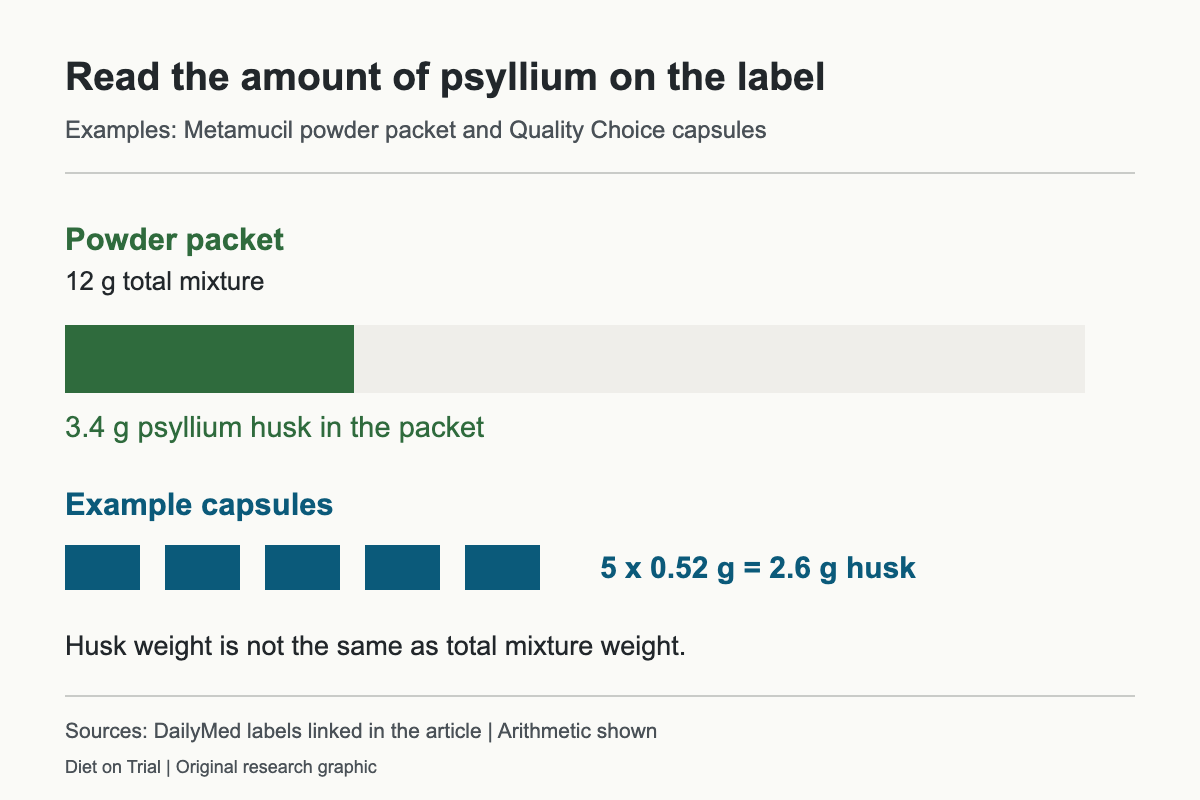
Psyllium is another fiber with its own evidence and label instructions. Its husk or soluble-fiber doses cannot be exchanged gram for gram with oat beta-glucan simply because both are called fiber.
Frequently asked questions
Is 3 g of total fiber the same as 3 g of beta-glucan?
No. Beta-glucan is a specific fiber. The total-fiber line does not establish that all of it is beta-glucan.
Will one bowl lower LDL by the review's average amount?
The review does not make that prediction. Its result summarizes groups consuming measured interventions over several weeks, not a single meal.
Did the trials show a rise in HDL?
The cited 28-trial analysis found no statistically significant HDL change. Its favorable results concerned LDL and total cholesterol.