On this page
Choose a psyllium form by its labeled amount and how you will take it. A capsule count and a spoonful of powder are not equivalent doses. Powder and granules require mixing, while capsules can mean swallowing several units. All forms need at least 8 ounces (240 mL) of liquid; capsules do not remove the choking precaution.
Compare husk amount before package size
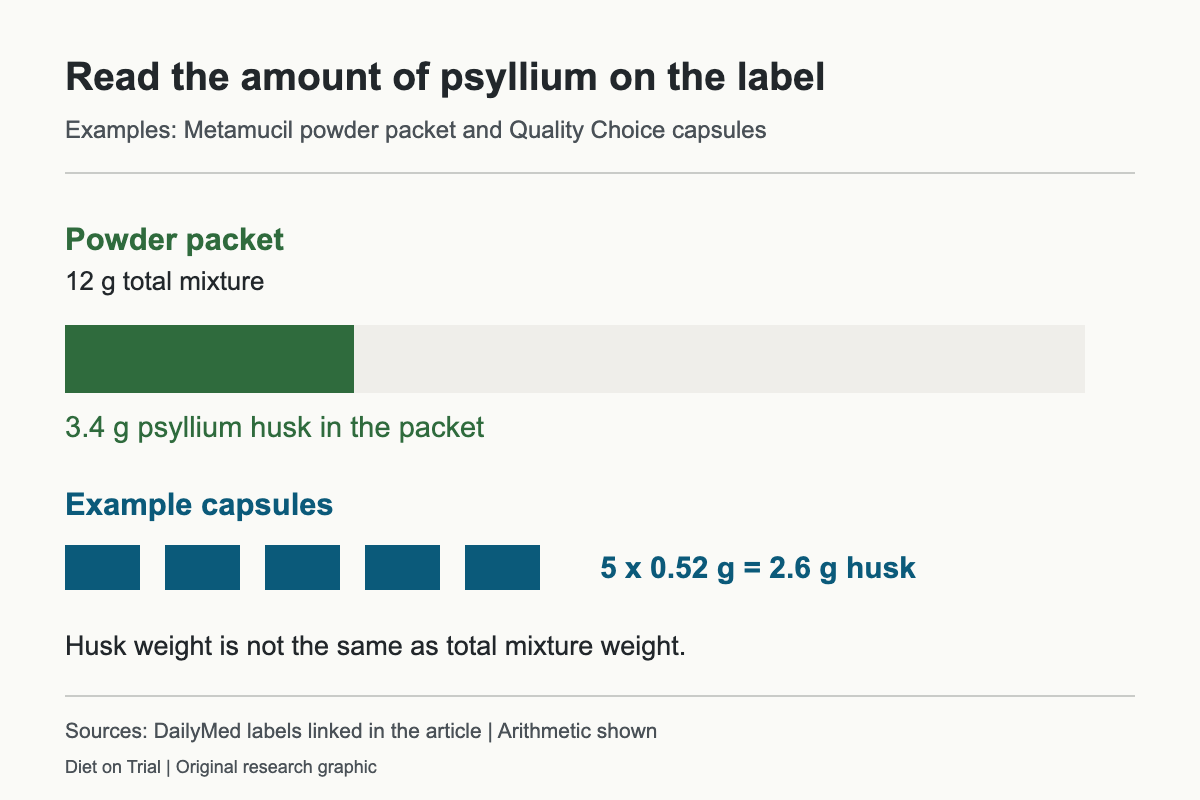
Two US drug labels show why the numbers need care. A Metamucil powder packet weighs 12 g but contains approximately 3.4 g of psyllium husk. A Quality Choice capsule contains approximately 0.52 g of husk; its labeled adult dose of five capsules therefore supplies approximately 2.6 g of husk.
| Label example | Unit on the package | Psyllium husk in that unit |
|---|---|---|
| Metamucil powder | One 12 g packet | Approximately 3.4 g |
| Quality Choice capsules | Five capsules | Approximately 2.6 g, calculated as 5 x 0.52 g |
These examples explain label arithmetic. They are not a head-to-head trial or a recommendation to substitute one label's dose for the other. Husk weight, dietary fiber and total mixture weight should retain their own names.
What changes between the forms?
MedlinePlus lists powder, granules, capsules, liquid and wafers as oral forms. Powder and granules are mixed with liquid immediately before use. Capsules avoid the mixing step, but the example capsule label instructs users to swallow them one at a time with a full glass of liquid.
For choosing a product, read the serving directions before comparing the price of a tub with a bottle. The number of packets or capsules alone does not say how many labeled servings the package contains. Flavorings and other ingredients also belong in the comparison when they affect what you can take.
Water and swallowing precautions
MedlinePlus specifies at least 8 ounces, or 240 mL, of liquid when taking psyllium. The DailyMed labels warn against use in people with difficulty swallowing. If chest pain, vomiting, or trouble swallowing or breathing occurs after a dose, seek immediate medical attention.
Do not take dry powder and then try to wash it down. Mix according to the label. The Metamucil directions say to stir briskly, drink promptly and add more liquid if the mixture thickens.
How should medicines and duration be handled?
Medicine spacing can be drug-specific. MedlinePlus names digoxin, salicylates including aspirin, and nitrofurantoin as requiring at least three hours of separation. Follow the instructions that apply to your medicine rather than extending one product's general spacing rule to every drug.
MedlinePlus also advises against self-treatment for longer than one week unless a doctor directs it. The longer durations used in research are a different context. The fiber evidence guide covers those constipation and cholesterol trials; the Korean fiber comparison addresses products sold in Korea.
Frequently asked questions
Are capsules automatically a lower dose?
The dose depends on the number of capsules and the husk amount in each. Read both values; capsule size alone does not establish the dose.
Does a 12 g powder packet contain 12 g of psyllium?
Not in the cited example. That packet contains approximately 3.4 g of husk. The remaining mixture should not be counted as psyllium.
Are granules proven better than powder?
The label and medicine-information sources cited here do not establish clinical superiority between the forms. They establish how the products are supplied and taken.